


There’s a reason black hangs in nearly every closet in the world. It’s the colour we reach for when we want to look pulled-together, slimmer, more sophisticated, or simply when we can’t be bothered to think. Black is the sartorial equivalent of a deep breath: safe, familiar, and reassuringly adult.
But here’s the uncomfortable truth that no one tells you while you’re standing in the fitting room: “goes with everything” is not the same as “flatters everyone.” Black is a wardrobe workhorse, yes - but for the majority of people, it’s quietly working against their face, not for it.
At Glow Theory, this is one of the first myths I’d like to gently dismantle. So let’s talk about what black actually does, who it actually loves, and what you can wear instead that gives you all the chic with none of the drain.
The seductive promise of black
Black earned its reputation honestly. It recedes, so it has a slimming effect. It’s non-committal, so it pairs with anything. It reads as formal, expensive, and authoritative. Coco Chanel built an empire partly on the little black dress, and decades of fashion editorials have reinforced the idea that black is the height of elegance.
The problem is that black became a default rather than a choice. We stopped asking whether it suited us and started assuming it was universally flattering - the colour you could never get wrong.
You can, in fact, get it wrong. Most people do.
What black actually does to a face
To understand why, you have to understand what black is in colour terms. It is the deepest, most saturated, coolest “neutral” there is - essentially the absence of light. When you place that much depth and coolness directly beneath your chin, one of two things happens.
If your natural colouring can match that intensity - if you have genuine depth and contrast in your features - black sits comfortably beside you. Your face holds its own.
But if your colouring is lighter, warmer, or softer than black (which describes most people), the fabric overpowers you. Black pulls focus downward and casts a subtle shadow upward onto the face. The result is that it amplifies everything you’d rather it didn’t:
Under-eye shadows look deeper
Any redness or ruddiness looks more pronounced
Fine lines and nasolabial folds gain definition
Warm or sallow skin can look tired and slightly yellow-grey
In short: the garment wins, and your face loses the contest.
Who black genuinely loves
Black is not the enemy. For the right colouring, it’s spectacular. The people who can wear true black straight off the rack tend to share three qualities:
Cool undertones (pink/blue rather than golden/peach)
Natural depth in their hair, eyes, or skin
High contrast between their features - think dark hair against fair skin, or rich skin with bright, clear eyes
In the seasonal colour system, this is classic Winter territory. A deep, cool, high-contrast Winter standing next to black looks crisp, dramatic, and effortlessly powerful, because black matches the intensity already present in their face.
Who black quietly drains
For everyone else - the warmer, lighter, and softer colourings - black tends to do more harm than good:
Springs (warm, light, clear) get washed out; black is too heavy and too cool, and it dulls their natural brightness.
Summers (cool, soft, muted) find black too harsh and too saturated; it overwhelms their gentle contrast.
Autumns (warm, deep, muted) clash with black’s coolness; it can make rich, golden skin look sallow.
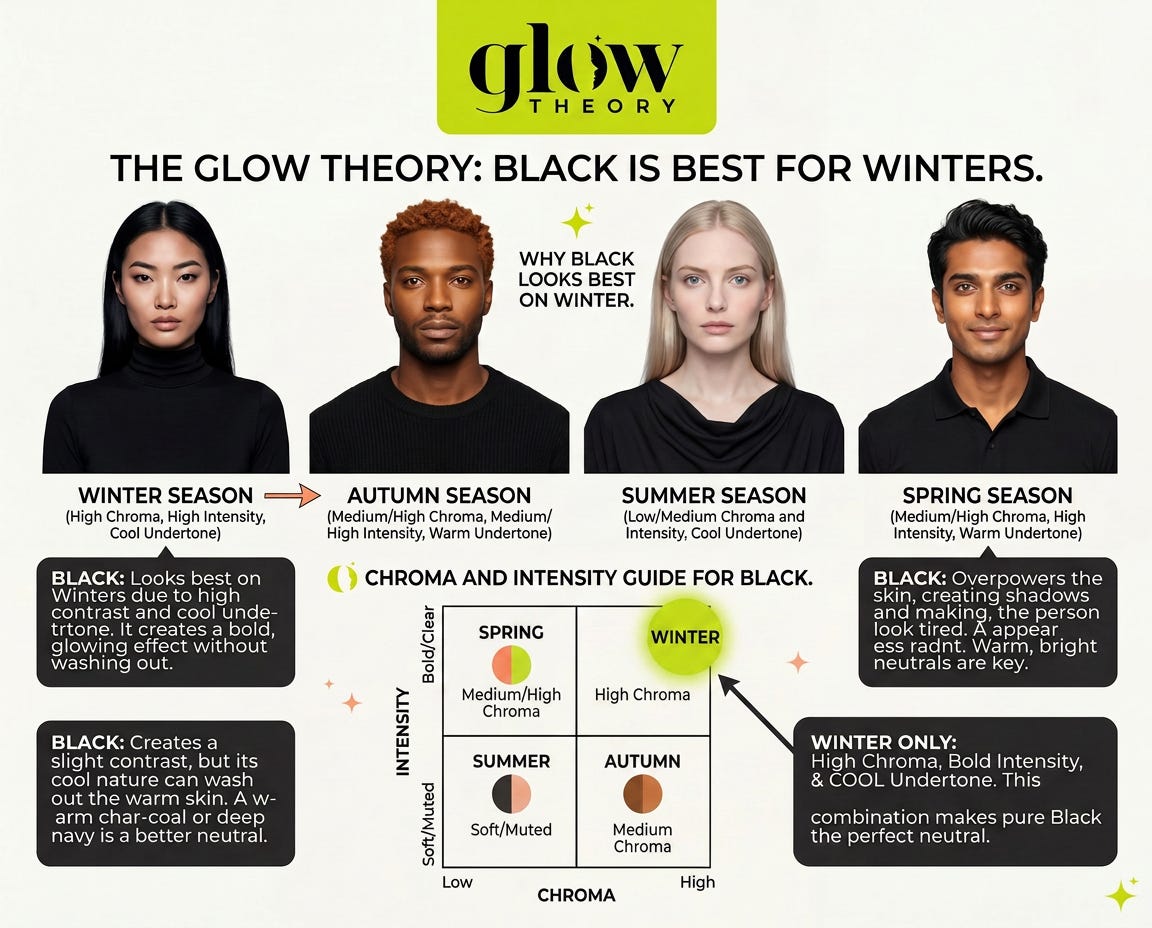
If you’ve ever put on a black top, glanced in the mirror, and thought I look tired today - it may not have been the day. It may have been the shirt.
Glow Check 🔍
In natural daylight near a window, hold a piece of true black fabric up under your chin. Look only at your face, not the fabric. Do your features look bright and defined - or does your skin look dull, shadowed, or tired while the fabric becomes the most noticeable thing? If the fabric wins, black isn’t your best neutral.
What to wear instead: finding your true neutral
Here’s the good news. Giving up black-as-default doesn’t mean giving up dark, chic, or versatile. It means swapping black for the deep neutral that actually harmonises with you. Everyone has one — often several.
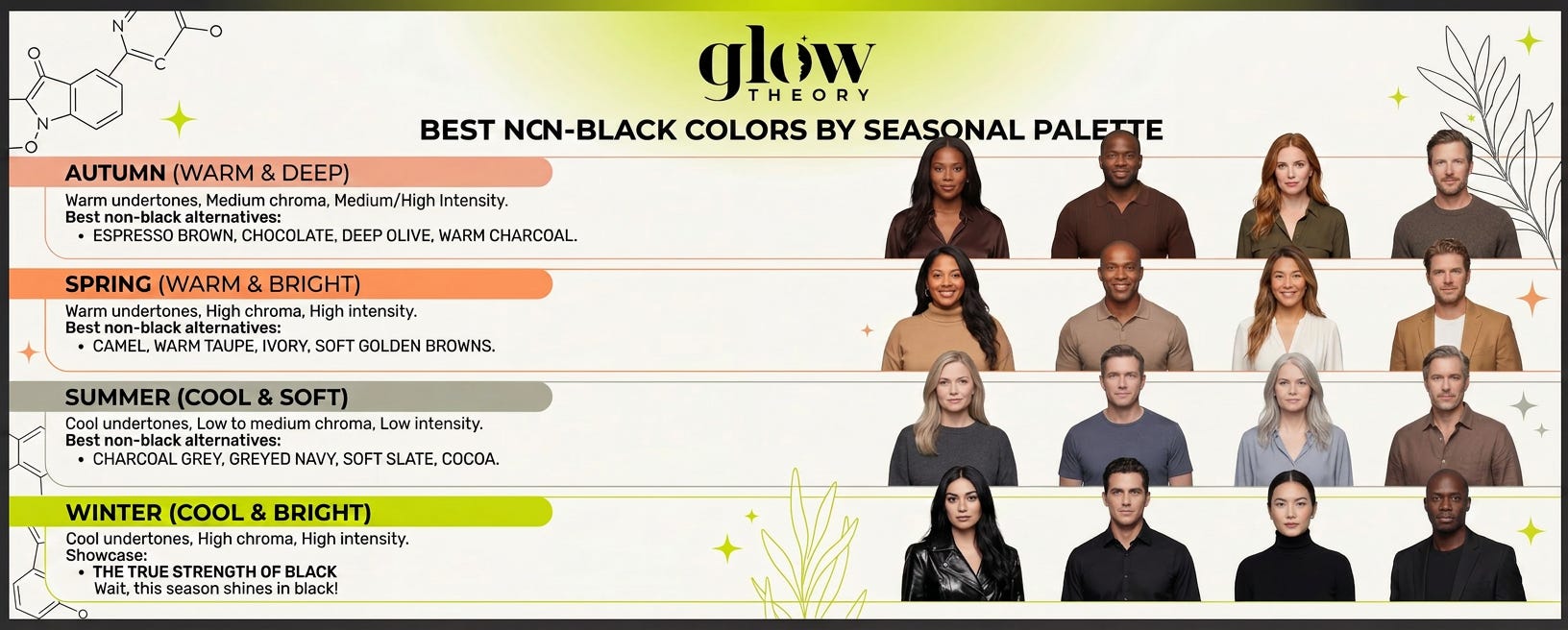
If you’re warm and deep (Autumn): espresso brown, chocolate, deep olive, and warm charcoal give you all of black’s grounding richness while flattering your golden undertone.
If you’re warm and light (Spring): camel, warm taupe, ivory, and soft golden browns keep you looking fresh and lit-from-within.
If you’re cool and soft (Summer): charcoal grey, greyed navy, soft slate, and cocoa offer sophistication without the harshness.
If you’re cool and deep (Winter): congratulations - true black is your neutral. But you can also play with navy, charcoal, and pure white for variety.
Navy, in particular, is the unsung hero here. A deep, well-chosen navy reads just as professional and slimming as black but is far more forgiving on the face for the majority of people.
How to make the switch without rebuilding your wardrobe
You don’t need to purge every black item tomorrow. Instead:
Move black away from your face. Black pants, skirts, and shoes are perfectly fine - the colour isn’t near your complexion. It’s black tops, dresses, and scarves that do the damage.
Add a buffer. If you love a black top, wear it with a scarf, necklace, or collar in your best neutral or colour near your face.
Replace the high-rotation pieces first. Swap your everyday black tee or blazer for your true neutral, and you’ll notice the difference immediately.
The Glow Theory takeaway
Black isn’t “bad.” It’s simply not the universal flatterer we’ve all been raised to believe it is. For most people, there’s a deep, sophisticated neutral that does black’s entire job - chic, slimming, versatile - while making the face look more alive instead of less.
The goal of colour analysis isn’t to take your favourites away. It’s to give you a palette where every choice works for you. And once you find your true neutral, you may find you don’t miss black at all.
Curious which deep neutral is truly yours? A Glow Theory colour analysis pinpoints your exact season - and the dark, elegant shades that will become your new everyday go-to.