


Hair colour is where colour analysis gets personal really quickly. Because it’s not just about what looks good in a shopping context - it’s about a decision that lives on your head, frames your face every single day, and either works with your natural colouring or spends all its time fighting it.
I’ve had so many conversations with people who’ve described a vague sense of wrongness about their hair - a colour they chose because it was trendy, or because their colourist suggested it, or because they saw it on a Pinterest picture of someone and loved it - but that has never quite looked the way they imagined. Often, the issue isn’t the style or the cut or even the technique. It’s the undertone of the colour itself.
Understanding your season gives you a framework for making hair colour decisions that work with your natural colouring rather than against it. It won’t remove the trial-and-error entirely - but it narrows the field significantly and prevents some genuinely costly mistakes.
Hair Colour for Springs
Springs have warm, clear natural colouring, and their best hair colours reflect and amplify that warmth. The goal for a Spring considering hair colour is always to lean into the golden, bright, and warm - never to cool things down.
The most flattering hair colours for Springs: golden blonde (not platinum, not ash - warm and sunny), honey blonde, strawberry blonde, warm light brown with golden or amber highlights, copper, and auburn. There’s a luminosity and warmth to all of these that harmonises beautifully with Spring’s peachy, golden skin.
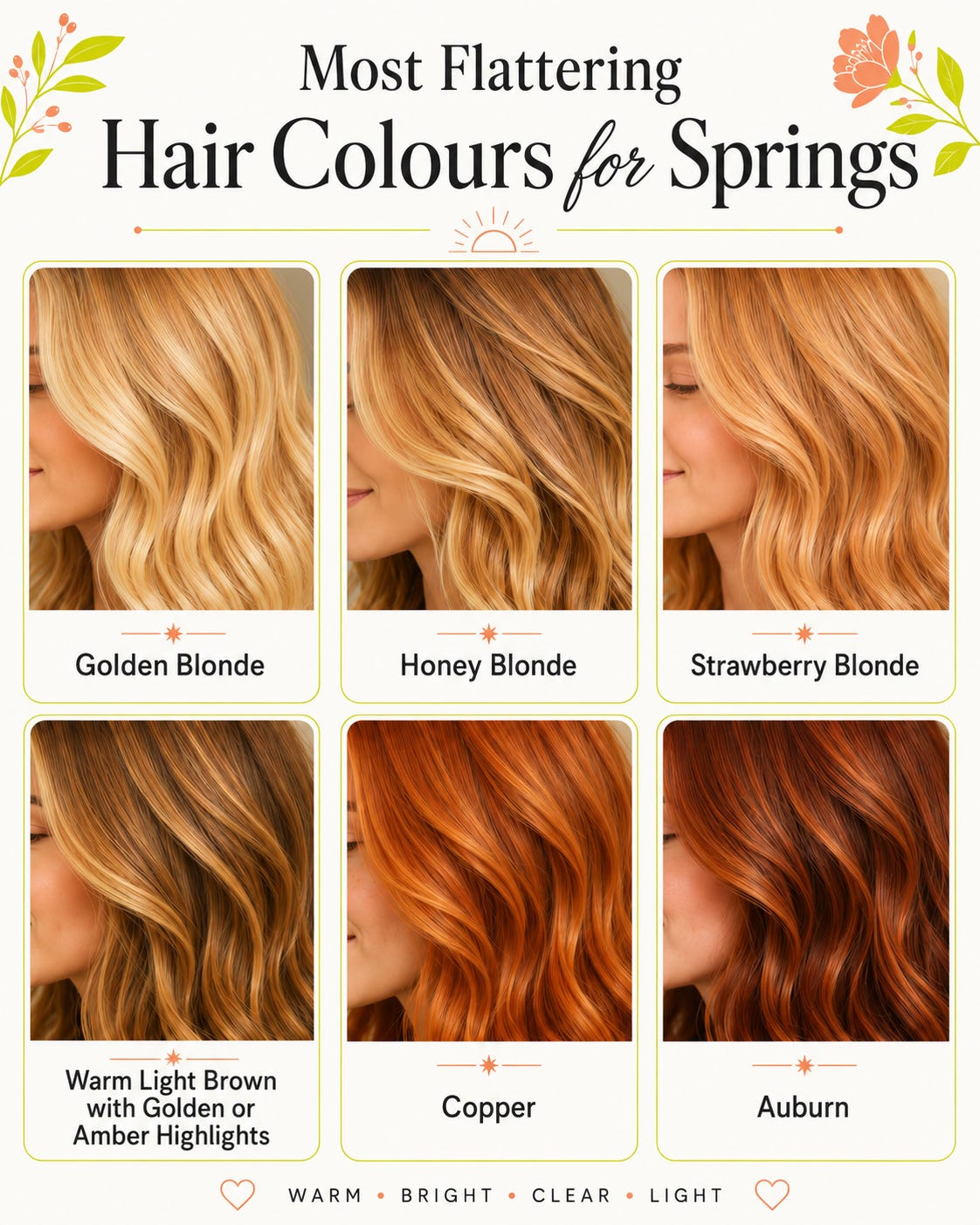
If you’re a Spring with naturally darker hair and you’re considering lightening it: go warm. Golden balayage, honey-toned highlights, warm caramel pieces - these are your friends. Going ashy or platinum when you’re a Spring often results in that slightly yellowish or unwell quality to the skin, because the cool tones of the hair are fighting against the warm tones of the complexion.
If you’re a Spring going grey: consider warm pearl or golden grey tones rather than cool silver. A warm grey on a Spring can be beautiful; a steel grey can make the complexion look a little dull.
Avoid: ash blonde, cool brown, platinum, and anything with a blue or violet toner. These cool the hair down in a way that works beautifully for other seasons but fights against Spring’s inherent warmth.
Hair Colour for Summers
Summers have cool, soft, muted colouring, and their hair colours should mirror that. The goal is cool and soft - never warm, never vivid, never golden.
The most flattering hair colours for Summers: ash blonde, cool light brown, cool medium brown, soft platinum, cool dark blonde, and - for those ready to embrace it - a cool silver-grey that harmonises beautifully with Summer’s natural undertones. Summers tend to go grey in one of the most elegant ways of any season: cool, silvery, and quietly beautiful.
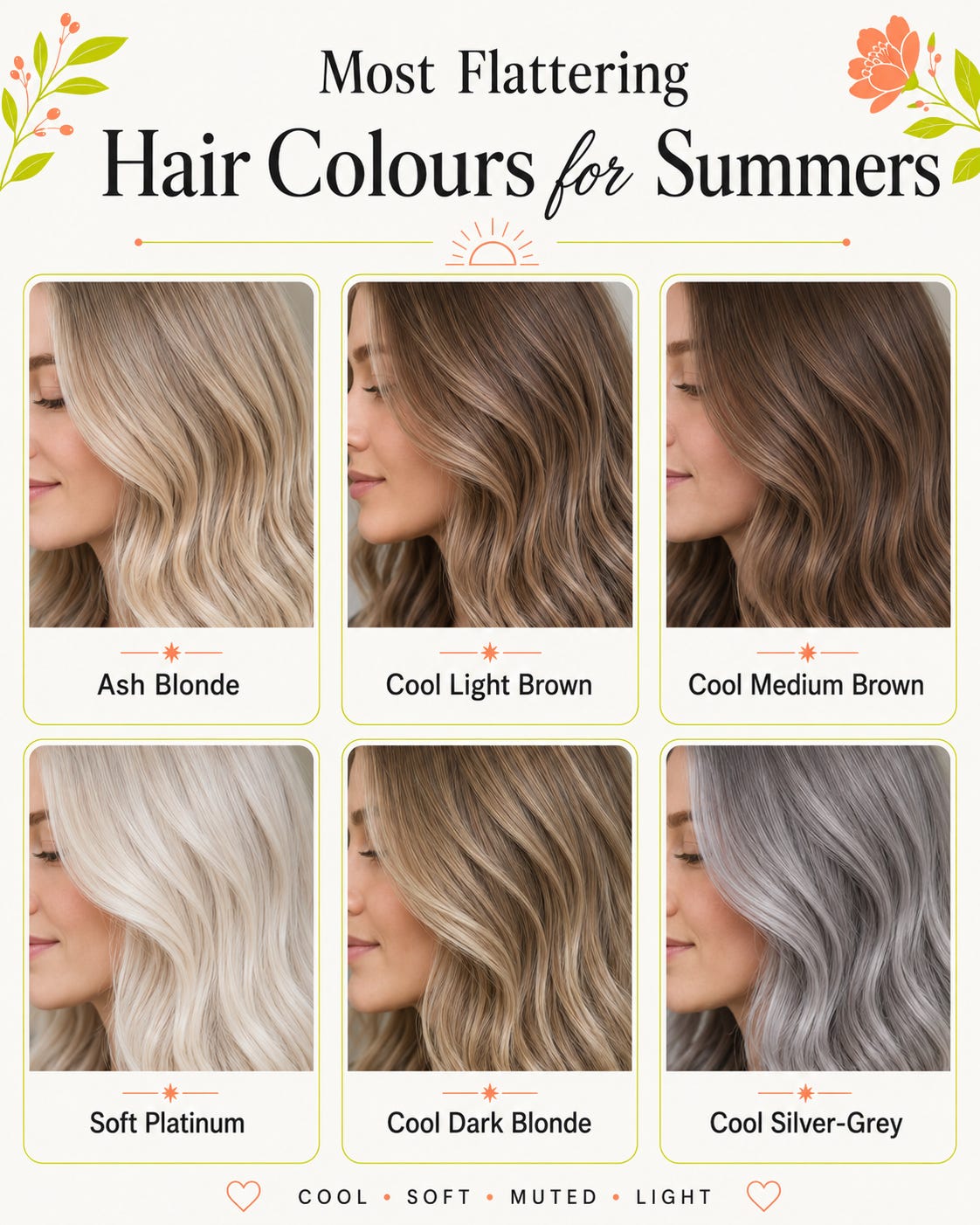
If you’re a Summer colouring your hair darker: look for cool browns with no redness or warmth to them. An ash brown or cool espresso, rather than a chestnut or warm brown.
If you’re a Summer adding highlights: cool, soft highlights in a slightly lighter version of your base colour, or soft platinum pieces. Not golden, not honey, not copper.
Avoid: warm golden blonde, copper, auburn, warm brown, and anything that has a warm or reddish tone. Warm hair colour on a Summer complexion often creates an orange or yellow cast to the skin that’s quite unflattering - it’s the colour version of that wrong-foundation-undertone problem.
Hair Colour for Autumns
Autumns often have some of the most naturally beautiful hair colour of any season - rich auburn, warm chestnut, golden brown, and deep copper are all quintessentially Autumn. The goal when colouring Autumn hair is to honour and deepen that warmth and richness, never to cool it down or strip it away.
The most flattering hair colours for Autumns: rich auburn, warm chestnut, copper, bronze, warm medium brown, warm dark brown, deep golden brown, and a warm near-black with brown or reddish undertones. There’s a richness and depth to all of these that feels entirely at home on Autumn colouring.
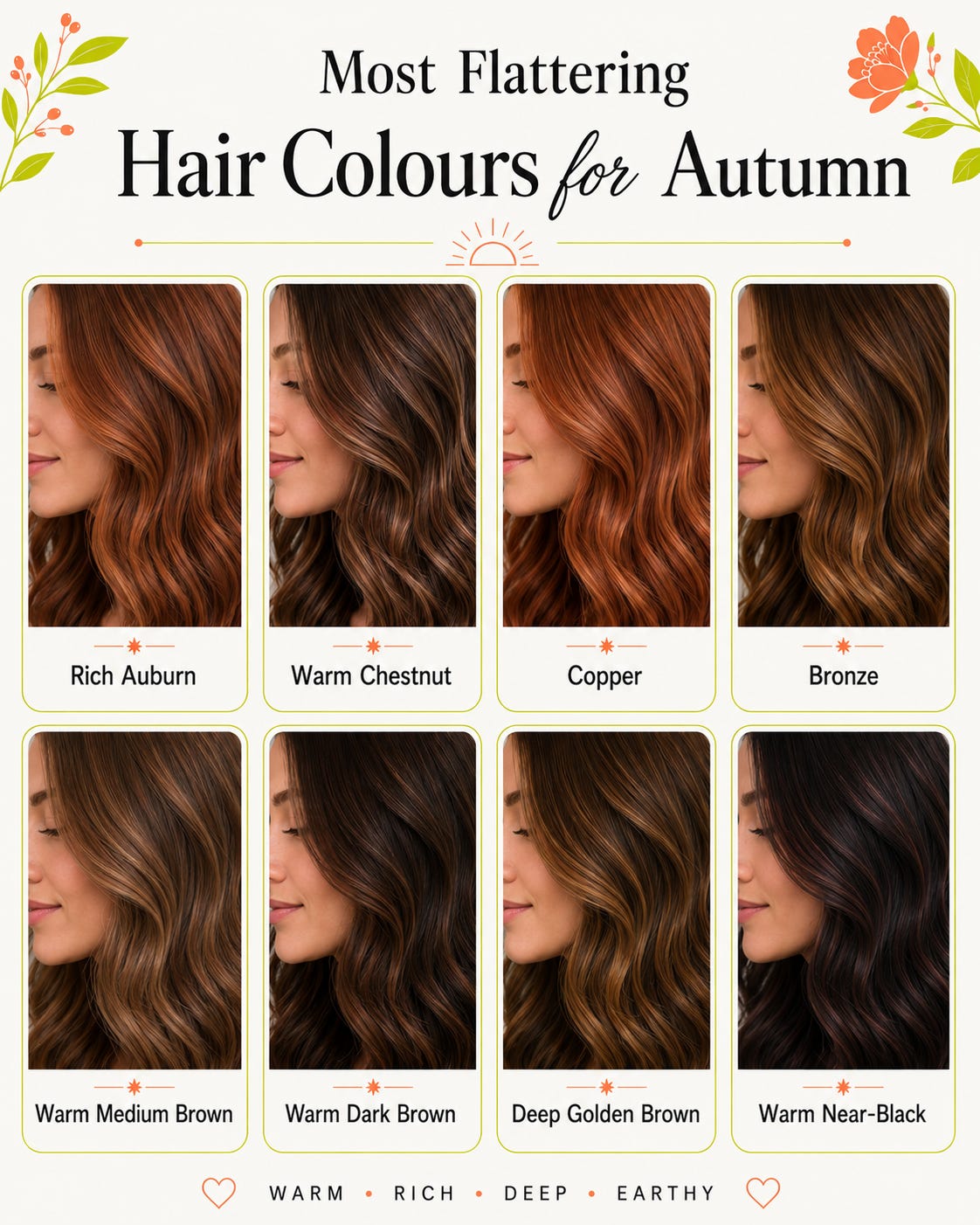
If you’re an Autumn going lighter: think golden and warm. Warm balayage, copper highlights, honey tones - the goal is warmth, not lightness for its own sake.
If you’re an Autumn going darker: deep warm brown, warm espresso, or a warm near-black. Never cool black - it has a harshness that fights against the warmth of Autumn skin.
Going grey as an Autumn: look for warm pearl grey, golden grey, or a grey that has warmth rather than coolness to it. Cool silver-grey on an Autumn can make the complexion look sallow.
Avoid: ash brown, platinum blonde, cool black, and anything that takes the warmth out of the hair. Autumns who go too cool or too ashy often find their complexion loses its golden glow - which is precisely the opposite of what you want.
Hair Colour for Winters
Winters tend to have naturally dramatic hair - very dark, very deep, or occasionally very light (platinum or near-white blonde). The goal with Winter hair colour is to maintain that sense of clarity and contrast, never to muddy or warm it.
The most flattering hair colours for Winters: true black, deep cool brown, cool dark brown, blue-black, and at the other extreme, cool platinum or icy white-blonde. What these have in common is a clarity and coolness - no warmth, no muddy middle ground.
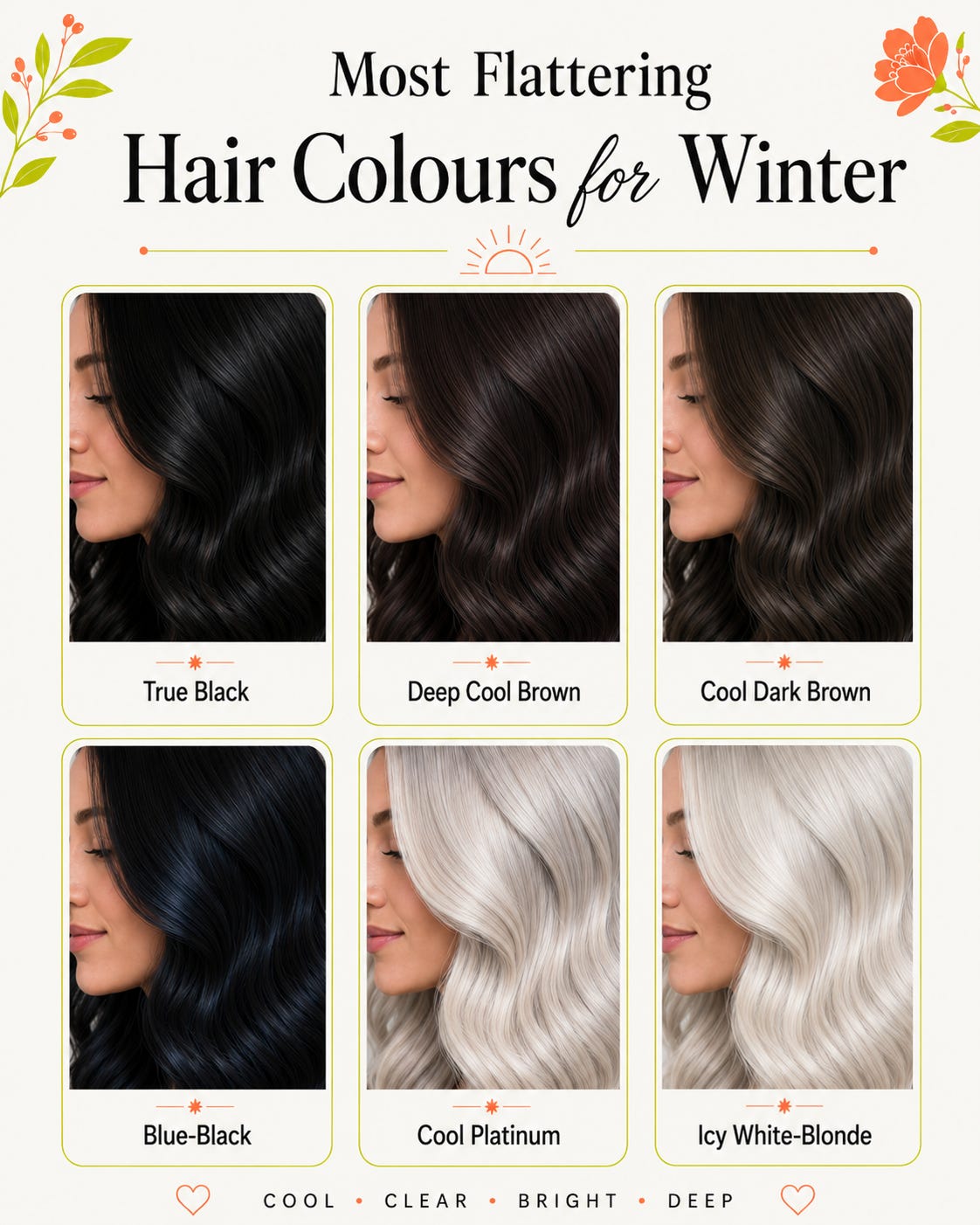
Winters going grey have the same elegant option as Summers: cool, silvery grey. On a Winter’s colouring, a crisp silver-grey looks absolutely striking. Many Winters actually look more themselves as their hair lightens with age.
If you’re a Winter colouring or maintaining dark hair: look for cool versions of dark shades. A true black or cool dark brown rather than anything with warmth or redness.
Avoid: warm, golden, or auburn tones. A Winter with warm highlights can look as though the hair and the face are telling different stories — there’s a visual disconnection that’s hard to put your finger on but immediately noticeable. Warm hair makes cool Winter skin look somehow more grey or washed out rather than warmer.
The drama of Winter hair - that deep, cool, high-contrast quality - is one of the season’s greatest assets. It’s worth protecting.
What About Highlights, Balayage, and Money Pieces?
One question I get asked constantly is whether the guidance above applies only to full colour changes, or whether it extends to highlights, balayage, and the smaller accent pieces that have become so popular in recent years. The short answer is: it applies to everything, but the margin for experimentation is a little wider with partial colour.
Highlights and balayage often sit right around the face - exactly where they’ll interact most with your complexion. A face-framing piece in the wrong undertone can have an outsized effect precisely because it’s positioned where your eye, and everyone else’s, naturally goes first.
That said, smaller pieces of colour give you more room to play, because they’re diluted by your base colour. A Summer with cool ash-brown hair might tolerate a few warmer babylights without it looking wrong, in a way that a full warm balayage wouldn’t. If you love to experiment but don’t want to commit to a full colour change, subtle pieces in your season’s direction are a lower-risk way to test the waters.
I’d also gently suggest talking to your colourist about undertones rather than just shade names. ‘Ash’ and ‘warm’ and ‘cool’ mean slightly different things to different colourists, and the toner used can shift a colour considerably from how it looks on a swatch. Bringing a reference - even a photo of a colour from your palette - can help bridge that gap and get you closer to the result you’re picturing.
A Final Note
These are guiding principles, not absolute rules. Life is too full and hair is too personal for rigid rules. And there are also questions of maintenance, cost, and your hair’s condition that rightly factor into every colour decision.
But if you’ve ever walked out of a salon feeling like something isn’t quite right - and you couldn’t put your finger on it - your season might be where the answer lives.
As part of my colour analysis sessions, I’m always happy to talk through hair colour in the context of your season. It’s one of the most practical applications of the work, and honestly, one of the most satisfying!